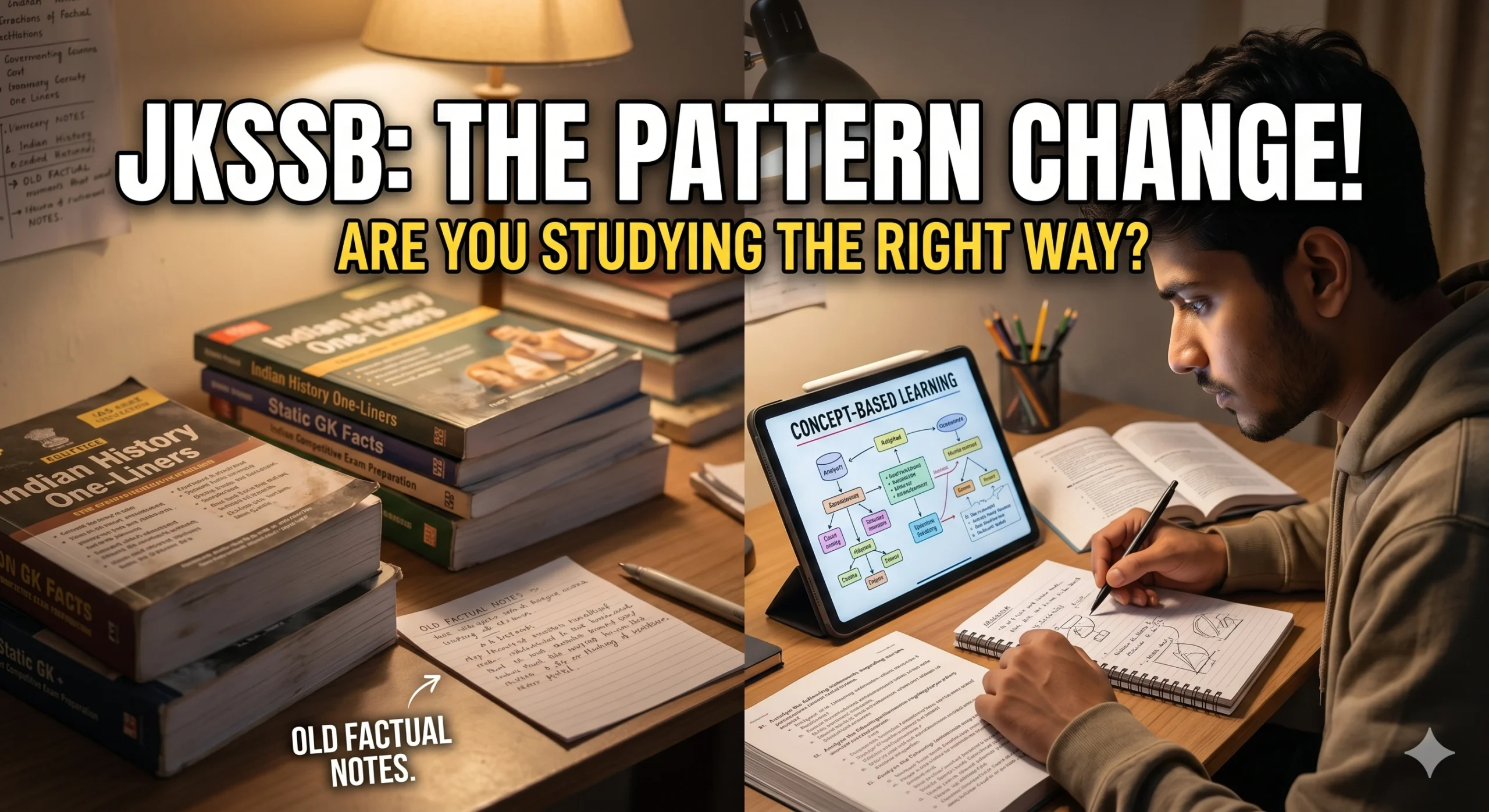
“I studied everything. I knew the answers. But the questions were asking something else entirely.”
That was my friend Amir, sitting outside the exam center in Srinagar after the JKSSB Accounts Assistant exam. He wasn’t wrong. He had covered all the standard topics — history, geography, polity, and current affairs. But what hit him inside that hall were questions he had never seen before in any JKSSB paper. They were statement-based. Analytical. The kind you typically associate with JKAS — the Kashmir Administrative Services exam.
That day was a wake-up call for a lot of us. JKSSB had quietly shifted gears. And most of us were still preparing for the old exam.
What Actually Changed — And When
If you’ve been following JKSSB papers from 2022 onwards, you’ll notice something: the pattern has been creeping closer and closer to JKAS-style questioning. It’s not dramatic. There was no official announcement saying “we’re changing everything.” It just… happened gradually.
Earlier JKSSB papers were largely direct. You’d get questions like: “When was the Dogra rule established?” or “Who was the first Prime Minister of J&K?” Straightforward recall. One correct answer, done.
Now the questions look more like this:
Example: Consider the following statements about Article 370:
1. It was a permanent provision of the Indian Constitution.
2. Its abrogation required a special majority in Parliament.
3. J&K had its own Constitution before 2019.
Which of the above statements is/are correct?
(a) 1 and 2 only (b) 3 only (c) 2 and 3 only (d) 1, 2 and 3
This is textbook JKAS territory. The same format. The same analytical trap. And JKSSB is now asking it regularly.
Why Is JKSSB Doing This?
Honestly, there are a few reasons — some official, some just based on what people in coaching circles have been saying.
First, the merger of J&K into a Union Territory brought a certain alignment with UPSC/central exam standards. The administration wants to test analytical ability, not just rote memorization. That’s a fair change, honestly.
Second, statement-based questions are better at differentiating serious candidates from those who simply memorized one-liners. When you’re selecting people for government roles — finance, accounts, education — you want someone who can think, not just recall.
And third — and this is the practical reality — JKAS has always been the gold standard for J&K competitive exams. JKSSB borrowing from that playbook gives their papers more credibility and reduces the probability of mass leaks of MCQ banks.
JKSSB vs JKAS: Where They Still Differ
| JKSSB EXAMS | JKAS EXAM |
| Multiple posts (finance, accounts, education, etc.) | Administrative service selection |
| Single-stage written test mostly | Prelims + Mains + Interview |
| Mix of direct + statement-based MCQs | Entirely analytical MCQs in prelims |
| J&K GK heavily weighted | Detailed UPSC-style syllabus |
| No essay or descriptive paper | Essays and descriptive answers in mains |
| Negative marking varies by post | Negative marking in prelims |
So while JKSSB hasn’t become JKAS, the question style — especially the analytical statement format — is now very much borrowed from it. The syllabus is still different. But what thinking is required to solve questions? Almost identical.
The New Strategy to Clear JKSSB
Here’s what I’d tell someone starting their JKSSB prep right now, based on what’s worked and what’s clearly not working anymore.
Step 1 — Stop reading facts, start reading concepts
- Shift from memorizing dates to understanding context. Knowing that the Simla Agreement happened in 1972 is less useful than understanding what it changed, what it didn’t, and what controversies surround it. Statement-based questions test this understanding, not the year.
- Read NCERT books — seriously. Class 9 to 12 History, Geography, Polity, and Economics. These aren’t just for UPSC. They build conceptual clarity that directly helps with statement-based MCQs. Most JKSSB statement questions are designed around exactly this level of depth.
- Solve JKAS previous year papers. This is the underrated hack. JKAS prelim papers are pure statement-format. Practicing them daily trains your brain to evaluate multiple claims at once — exactly what JKSSB is now asking you to do.
- Build a “true/false filter” for common topics. For every major topic — J&K history, Indian Constitution, environment, economy — make a list of commonly believed facts and verify which are correct. Statement questions love to plant one wrong claim among three right ones.
- Don’t skip elimination practice. Even if you’re not 100% sure, learning to eliminate obviously wrong statements narrows it to a 50/50 choice. That’s a skill, and it’s trainable. Give yourself timed mock sessions specifically for this.
What Resources Actually Work Right Now
I won’t pretend I cracked some secret code. But here’s what has genuinely helped candidates in my circle who cleared JKSSB posts in the last two years:
Resources worth your time:
— JKAS prelim papers 2018 to 2024 (freely available on jkpsc.nic.in)
— Laxmikant’s Indian Polity (for constitutional statement questions — a must)
— J&K at a Glance (published by J&K government — best J&K GK source)
— The Hindu or Tribune — 15 minutes daily is enough, focus on J&K coverage
— Testbook or KVS app for timed mock tests with statement MCQs
For YouTube, channels run by J&K educators like Study91 J&K or local Srinagar-based coaching accounts on Telegram have started specifically addressing this shift. They’re doing mock sessions modeled on JKAS-style questions for JKSSB aspirants. That’s the direction to move in.
One Thing Nobody Tells You
The mental shift is harder than the academic one. Most JKSSB aspirants come from a background of rote preparation — coaching centers that drill direct questions, notes with one-liners, practice sets built around old patterns. Switching to analytical thinking feels uncomfortable at first.
I remember the first time I sat with a JKAS paper. I felt completely lost. Two or three statements, all sounding plausible, and I had no idea how to approach it. It took me about three weeks of daily practice before it started feeling natural.
It will feel that way for you too, in the beginning. That discomfort is the learning happening. Don’t quit and go back to direct-question sets just because it’s easier. The exam has moved. Your prep needs to move with it.
The aspirants who clear JKSSB in 2025 and 2026 are the ones who understood this shift early. They’re not necessarily the smartest in the room — they’re the most adaptable. They realized that JKSSB is no longer testing what you know. It’s testing whether you can think with what you know.