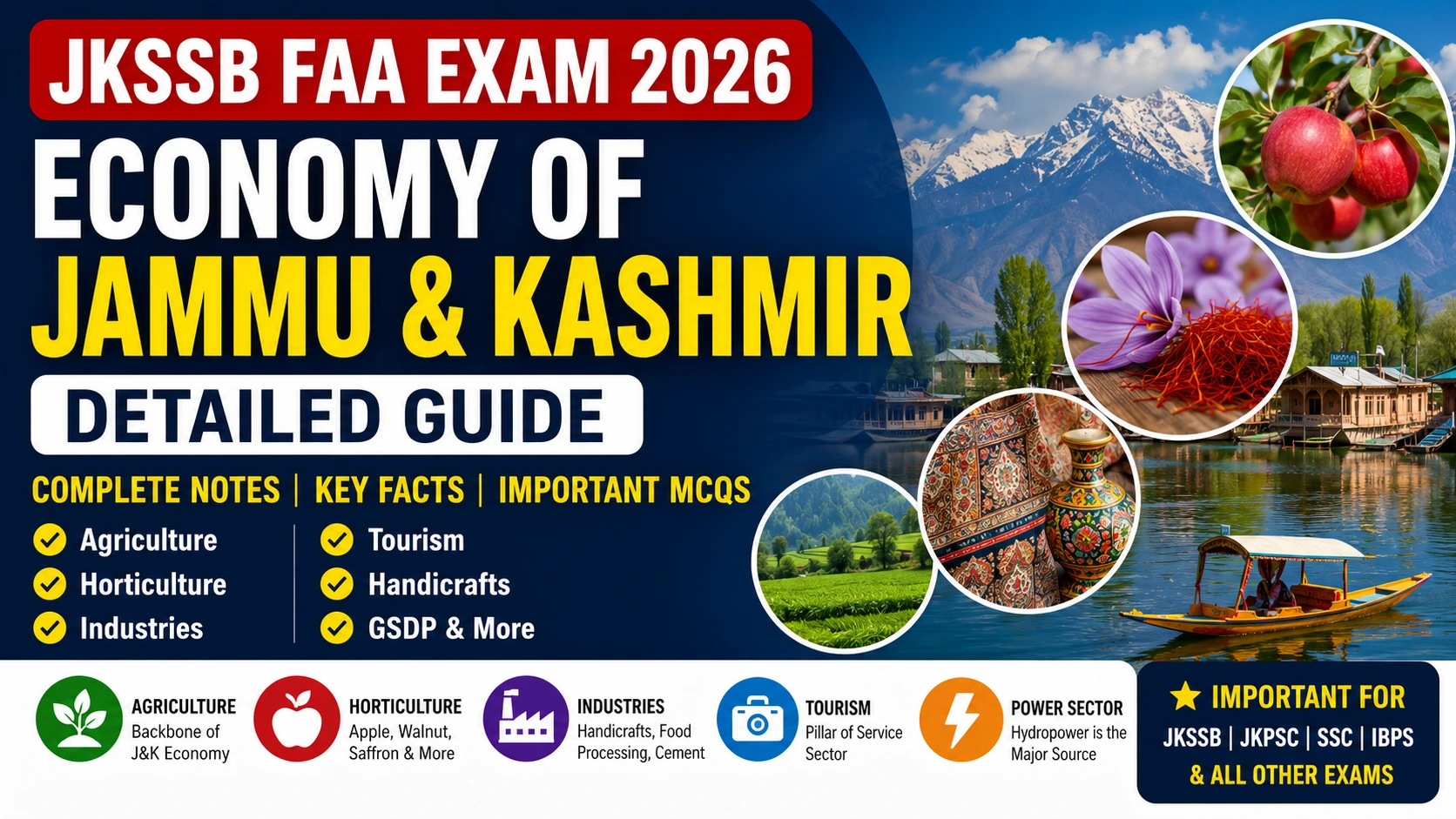
The UT of Jammu and Kashmir has its own cultural identity. Geographically, it shares international boundary with Pakistan only. National boundaries with Ladakh, Punjab, and Himachal Pradesh. The UT has very high terrain which impedes industrial growth. The land of the UT is highly fertile and water resources are abundant. Jammu and Kashmir UT is richly endowed with forests as well as with mineral resources like coal, lignite, copper, lead, zinc, cobalt, limestone, bauxite, borax, and precious stones.
The economic growth of Jammu and Kashmir has been erratic due to various reasons, one of which is political instability. The erstwhile state of Jammu and Kashmir was bifurcated into two UTs of Jammu and Kashmir and Ladakh in August 2019. One of the stated reasons for bifurcation was the lack of economic development. Service sector contributes most to the GDP of UT while agriculture supports majority of population of the UT. Industry is the second major contributor toward the state economy, while agriculture contributes the least. The tourism sector plays an important role in the UT economy.
The sector has huge potential for employment generation even for unsecured manpower. According to the Center for Monitoring Indian Economy (CMIE), Jammu and Kashmir has a 22.2% unemployment rate, which is the most worst among states/union territories in India. However, as per National Statistical Office N S O, the estimates of unemployment rate in Union status in Jammu and Kashmir fluctuates between 5.1% and 6.7%. Gross Domestic Product of Jammu and Kashmir (GSDP).
Gross Domestic Product Of J&K (GSDP)
Gross State Domestic Product (GSDP) is the total value of goods and services producing during any financial year with the geographical boundaries of state/UT, also known as the state income. GSDP is always calculated or estimated in monetary terms and is instrumental in the evaluation of per capita income. It serves as an indicator for measuring economic prosperity of the state UT and to study the structural changes takes place in the economy. The sectoral composition of gross state value added (GSVA) gives an idea about the relative position of different sectors in the economy over a period of time, which not only indicates the real structural changes taking place in the economy but also facilitates in formulation of the plans for overall economic development.
Key Economic Indicators (2025 to 26)
| Nominal GSDP | ₹2.86 lakh crore |
| Real GSDP Growth Rate | 5.82% |
| Nominal GSDP Growth Rate | 8.89% |
| Per Capita Income | ₹1,68,243 |
| Services Sector Share in GSVA | Around 61% |
| Population Dependent on Agriculture | About 70% |
Agriculture and Allied sectors.
Jammu and Kashmir UT is predominantly as an agrarian economy. Nearly 70% of the population is directly or indirectly dependent on the agriculture sector for its livelihood. Agriculture contributes around 15% to the GSDP. The UT is basically monocropped and rainfed economy. Only about 46% of the total cultivated land in is irrigated. Farmers in Jammu and Kashmir are officially recognized as marginal farmers because of very small agricultural land holding estimated at 0.55 hectares during the agriculture census 2015 to 2016.
As per recent report of Niti Aayog, among all state UTs, Jammu and Kashmir is the third rank holder in the monthly income to agriculture households and fifth best performing UT in agriculture and allied sectors.
Jammu and Kashmir: Population, Cultivated Area, Irrigated and Unirrigated Area
| Region | Population (Census 2011) | Net Cultivated Area (Lakh Hectares) | Irrigated Area (Lakh Hectares) | Unirrigated Area (Lakh Hectares) |
|---|---|---|---|---|
| Jammu Division | 53,50,811 | 4.52 | 2.48 | 2.04 |
| Kashmir Division | 69,07,623 | 2.82 | 0.82 | 2.00 |
| Jammu and Kashmir (Total) | 1,25,41,302 | 7.34 | 3.30 | 4.04 |
The major crops of Jammu and Kashmir including rice, wheat and maize. The UT comprises of two regions, namely Jammu and Kashmir, having distinct geographical outlook and agro climatic zone, each known has its own characteristic that largely determines the cropping pattern and productivity of crops. Paddy is the main crop of Kashmir following by maize, oil seeds, pulses, vegetables, fodder and wheat. In Jammu region, wheat is predominant crop followed by maize, paddy, pulses, oil seeds, fodder, vegetables and other crops.
| Crop | Production (Approx.) | Unit |
|---|---|---|
| Paddy (Rice) | 58.7 lakh quintals | 2024 to 25 estimate |
| Maize | 52.0 lakh quintals | Latest available estimate |
| Wheat | 46.0 lakh quintals | 2024 to 25 estimate |
| Total Foodgrains | 211.81 lakh quintals | 2024 to 25 |
Saffron (Crocus Sativus)
Jammu and Kashmir agriculture has an international identity due to the world’s high quality saffron which is grown in valley. It is major intensity in Pulwama and Badgam districts. Nearly 98% of the total area under the crop is cultivated in Kashmir province. It is cultivated in Jammu division in confined to few pockets of District Kishtwar.
The UT holds first position in the country in the production of saffron. Saffron is the world’s most expensive spice. It has long history of use in traditional medicine. It has also been used as a fabric dye. Aspirion in China and India and in perfumery. It is used for religious purpose in India. It is used in Persian, Indian, European and Arab cuisines.
At the present time, the saffron has showed a decline in trend in production and productivity because of the shrinking of its area. The area under this crop has declined from 5707 hectare in 1997 to around 3674 hectare in 2021. Besides saffron yields has shown a sharp decline from 3.13 kg per hectare to 2.5 kg per hectare. In 2020, the Jammu and Kashmir government issued the certificate of geographical indication GI registration for saffron growth in Kashmir Valley.
A geographical indication GI is a sign used on products that have specific geographical origin and possess quality or reputation that are due to that origin. With the G I tag, Kashmir saffron will acquire more prominence in the export market and would help farmers get the best remunerative price.
Horticulture
The horticulture sector plays an important role in the UT and it is important source of GSDP and also source of livelihood for substantial portion of the population of the Jammu and Kashmir UT. It generates approximately rupees 10,000 crore annually in come and contributes about 8% to the GSDP. Around 7.5 lakh families slash 35 lakh population about 27% earn livelihood through this sector.
The area under cultivation of fruits in Jammu and Kashmir increased from 2.21 lakh hectares in the in 2001 to 3.33 lakh hectares in 2021, thus registering an increase of 1.22 lakh hectares in two decades. The fruit craft grown in the UT are apple, almonds, walnuts, pears, cherries, and apricots in temperature areas and mango, citrus, lichi, papaya, guava, etc. in sub-tropical areas. Among the various crops, apple and walnut are the major temperature fruit crops, accounting for about 75% of total area and 55% of the temperature temperate fruit production respectively.
In India, total apple production is approximately about 28 lakh metric tons and of which 20 lakh metric tons are produced from Jammu and Kashmir.
Industry Sector
Industry is the secondary second secondary sector of economy. Agriculture and allied activities is primary sector and service in territory sector. It involves changing of form of goods to enhance their value, which requires input in form of capital, labor, power, raw material, entrepreneurship, etc. The output is finished goods which can be used again as raw material for another manufactured goods or consumed in its present form.
Thus the development of industry is a particular area depends upon the availability of raw material, minerals, power, capital, labor, infrastructure and managerial skills. Economy of Jammu and Kashmir UT established of industries also influenced by the general climatic conditions, whether industrial in Sharia and government policy.
The UT of Jammu and Kashmir through rich in water and forest resources have very few metallic resources. The non-availability of iron ore, copper, good quality coal, petroleum and natural gas are the major constraints in the development of large industries and manufacture centers.
Handicrafts and handloom
Handicrafts and handloom occupy an important position in the economic structure of Jammu and Kashmir UT. The handicrafts and handloom activities are best suited to the UT as these activities are more labor intensive, less capital intensive and low energy consuming in nature. Therefore, having scope for employment generation opportunity at large scale. The twin sector provide direct and indirect employment to artisans, weavers and ancillary workers.
Most belong to the backward economically weaker section of the society, concentrated in rural and far-flung areas. Jammu and Kashmir handicrafts and handloom produced products have one worldwide fame for their attractive design, functional utility and high quality crafts. Handicrafts produced of Kashmir include craft shawls, wood carving, chain stitch, paper machie, crewel, namda, sozi and staple embroidery, etc.
Tourism
Tourism in Jammu and Kashmir is one of the most important sectors of economy. Jammu and Kashmir is endowed with topographic diversity, pristine natural beauty and several religious shrines. Besides its natural beauty, Jammu and Kashmir also offers many adventure tourism opportunities in the form of trekking, skiing, paragliding, camping, angling, rafting, motoring and rock climbing. Being the largest service industry, tourism is the major source of employment, foreign exchange and infrastructure development. Tourism contributed around 7% to the GSDP of Jammu and Kashmir UT and generates employment for more than one lakh people.
Tourist Arrivals in Jammu and Kashmir, Latest Data
The latest officially available complete data is for the year 2025. As of June 2026, full year 2026 figures are not yet available. However, official data for the first few months of 2026 has been released.
| Year | Domestic Tourists | Foreign Tourists | Total Tourist Arrivals |
|---|---|---|---|
| 2023 | 2,09,74,000 (approx.) | 55,337 | 2.10 crore |
| 2024 | 2,35,00,000 (approx.) | 65,452 | 2.36 crore |
| 2025 | 1,77,28,980 | 36,410 | 1,77,65,390 |
| Jan to May 14, 2026 (Kashmir Valley only) | 5,13,286 | 8,195 | 5,21,481 |
In Conclusion
Jammu and Kashmir’s economy is driven mainly by agriculture, horticulture (especially apples and saffron), tourism, handicrafts, and services, while hydropower and infrastructure development offer important opportunities for future growth.