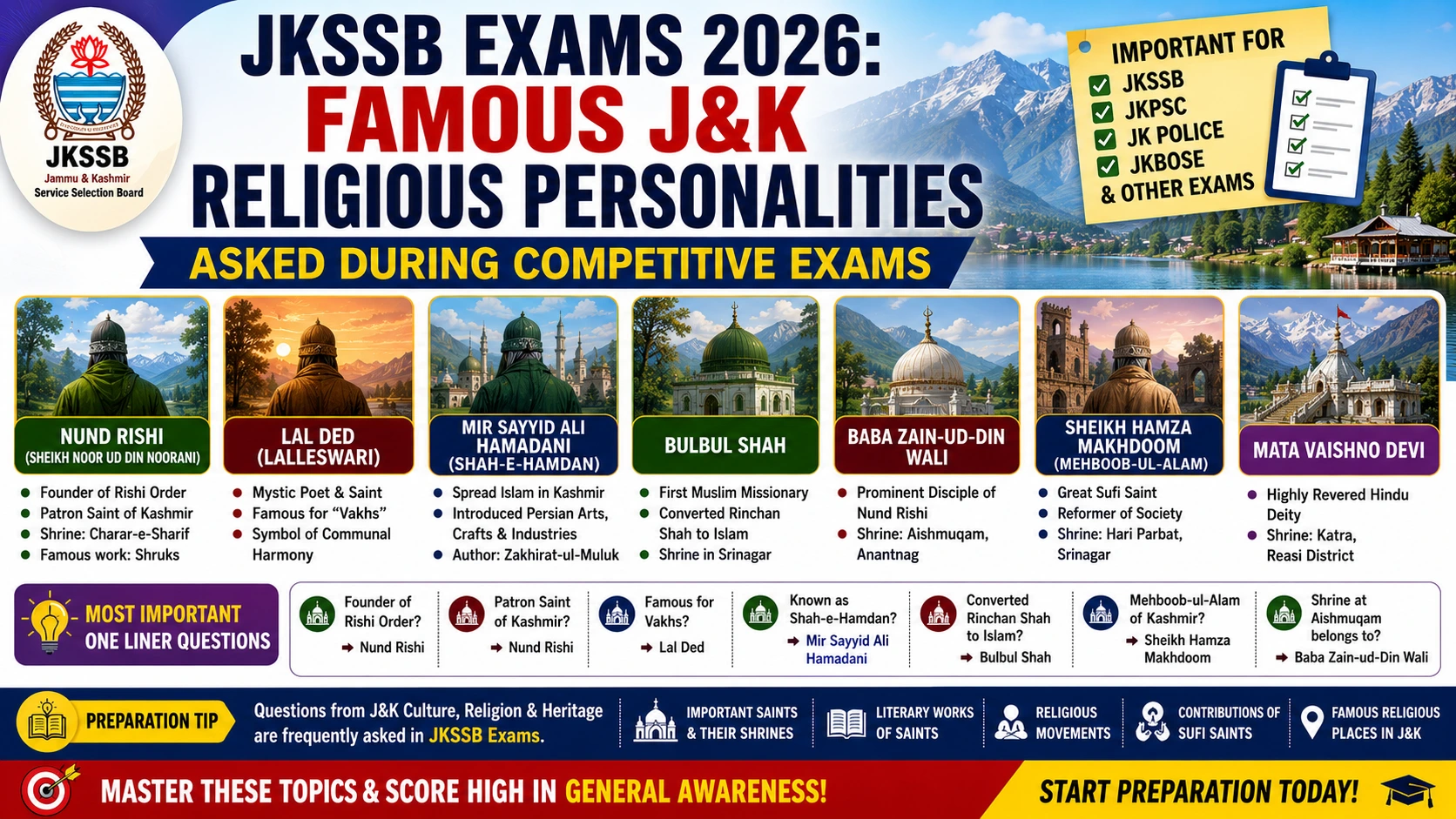
JKSSB Exams 2026: Questions related to religious saints, Sufi personalities, and spiritual reformers of Jammu and Kashmir are regularly asked in JKSSB, JKPSC, JK Police, JKBOSE, and other competitive examinations. Candidates preparing for the upcoming JKSSB Exams 2026 should thoroughly revise these important personalities.
Below is a list of the most important religious personalities from Jammu and Kashmir, along with their contributions and exam-oriented facts.
1. Nund Reshi
Nund Reshi, also known as Sheikh Noor-ud-Din Noorani (RA) and Alamdar-e-Kashmir, was a Kashmiri sufi saint, poet, and Islamic preacher.
- Nund Reshi was among the founders of the Rishi order.
- He was influenced by spiritual teachers and saints, including Hamza Makhdoom, Resh Mir Saeb, and Shamas Faqir.
- Noor-ud-Din was born in the modern-day village of Qaimoh in Kulgam District in 1377 AD to Salar Sanz and Sadra, also called Sadra Moji or Sadra Deddi.
- Noor-ud-Din renounced worldly life at the age of 30 and retired to live a life of meditation in a cave, which is still shown in Qaimoh and is about 10 feet deep.
- Noor-ud-Din is also credited with translating the Quran into the Kashmiri language.
- The Afghan governor, Atta Muhammad Khan, minted coins with Noor-ud-Din’s name.
- Noor-ud-din died in 1438 at the approximate age of 63.
2. Baba Zain-Ud-Din Wali (RA)
In the Reshi order, Baba is recorded as the second dearest friend of Nund Rishi, the highest regarded saint of Kashmir.
- Baba Zainuddin was born at Banderkut, Kishtwar at Rajput Hindu named Jai Singh. He also entered the Rishi fold at the hands of Nund Reshi.
- He was asked to report to the cave of Ashmuqam, where he could meditate in search of the truth. When he reached the cave, he saw it filled with snakes. Baba told them that this cave had not been allotted to the saint, so please leave the support. Snakes left the cave for the Baba, where mediated for years at attainment the enlightenment. He then came to be known as Sakhi Zainuddin Rishi.
- Baba Zainuddin Rishi, more popularly known as Sakhi Zainuddin of Ashmuqam, is one among the most celebrated Rishi saints of this land, who lived in the 15th century AD. He is one among the founders of the Kashmiri Rishi order and is remembered for his open-heartedness and generosity for centuries.
- The Urs is always celebrated with full religious honor and cultural gaiety in the entire South Kashmir, and several glorious functions were held across the valley in memory of the great saint. The most attractive and distinguished function held here is that of lighting up wooden torches locally known as Zoul on the eve.
3. Lal Ded
Lal Ded, known as Lalishwari in other parts of the subcontinent, was a Kashmiri mystic of the Kashmir Shivaism Sukula philosophy.
- She was the creator of Sitla mystic poetry called Vatsun, or Vakhs, literally “speech, voice,” known as Lal Vakhs. The verses are the earliest compositions in the Kashmiri language and are an important part of the history of modern Kashmiri literature.
- She inspired and interacted with many Sufis of Kashmir.
- She is also known by various other names, including Lal Ded, Mother Lala, Lala Arifa, Lala Didi, Lalishwari, Lala Yogeshwari, and Lali Shri.
- Lalishwari was born in Pandrethn, about 4.5 miles to the southeast of Srinagar, in a Kashmiri Hindu family during the time of Sultan Alauddin.
- Her poems, called Vakhs, have been translated into English by Richard Temple.
4. Mir Sayyid Ali Hamadani (RA)
Mir Said Ali Hamdani was a poet and a prominent Muslim scholar. He was born in Hamdan and was buried in Khatlan, Tajikistan.
- He was known as Shahi Hamdan, King of Hamdan, Amir Kabir, the great commander, and Ali Sani, the second Ali.
- Said Ali Hamdani traveled widely. It is said he traversed the known world from east to west three times. In 774 in 1372 AD, Hamdani lived in Kashmir.
- After Sharaf-ud-Din Abdul Rahman Bulbul Shah, he was the second important Muslim to visit Kashmir.
- Hamdani went to Mecca and returned to Kashmir in 781/1379. Stayed for two and a half years and then went to Turkistan by way of Ladakh. He returned to Kashmir for a third time in 785/1383 and left because of ill health.
- Hamdani is regarded as having brought various crafts and industries from Iran into Kashmir. It is said that he brought with him 700 followers.
- He wrote Zakhirat- ul Mulk.
5. Hamza Makhdoomi (RA)
Hamza Mukhdoomi, Kashmiri popularly known as Mukhdoom Sahib, was a Sufi mystic scholar and spiritual teacher living in Kashmir.
- He is sometimes referred to as Mahboob ul Alam, literally beloved of all, and Sultan ul Arifin, literally king of those who know God.
- Hamza Mukhdoom was born in a village of Tujar near Sopore in the Baramulla district.
- He died at the age of 82 in the year 1576 in Srinagar.
- His shrine, located on the southern slope of Hariparbat Hill and popularly called Mukhdoom Sahib or Hazrat Sultanul Arifin, is an important pilgrimage center in Kashmir.
6. Mohammad Anwar Shopiani
Muhammad Anwar of Shupian or Molvi Muhammad Anwar of Shupian was the founder of the Ahl-e-Hadith in Jammu and Kashmir.
- A significant poet-preacher of the period is Molvi Anwar Shah Shupian.
- He belonged to the Wahabi sect of Muslims. Deeni Diwani Anwar, a collection of poems in the form of an anthology according to Arabic alphabetical order, was published in 1935 in Lahore.
7. Bul Bul Shah (RA)
Hazrat Bulbul Shah is known as the first Muslim missionary in Kashmir.
- Hazrat Sayyid Bulbul Shah was a great scholar, a man of letters, and a theologian.
- He eliminated the darkness of the hearts with the torch of faith.
- Tashreen of Hazrat Sayyid Sharifuddin Abdul Rahman, known as Bulbul Shah, the first Muslim Sufi saint from Central Asia to have arrived in Kashmir in 1324 AD, is located in downtown Srinagar.
- Abdul Rahman is believed to have traveled all the way from Turkistan and settled in Kashmir roughly around 1324 AD. He reached Kashmir with his friend Mullah Ahmad.
- Some said he came to Kashmir with 1000 refugees out of fear of the Mongolians. Others believe he entered the valley in 1324 AD during the reign of Rinchin Shah.
- Rinchin Shah was a seeker of truth. He embraced Islam under the assumed name Saduruddin. He also led thousands to become Muslims.
8. Sheikh Baba Shadi Shaheed
Sheikh Baba Shadi Shaheed, formerly named Maharaja Dharmchand Rajput, after converting to Islam, was called Raja Shadab Khan.
- Raja Sufi Saint, he was the first Chibra Rajput converted to Islam during the reign of Babar. He was a famed wise man who was requested to treat the ailing emperor in Delhi.
- As a reward, Babar gave his daughter in marriage to him. Raja Shadi Khan was a contemporary and feudatory of the emperors Babar, Humayun, and Akbar, and he ruled over the districts of Bimber and Nowshehra with the present limits of Jammu and Kashmir.
- In consideration of services rendered to the emperor Akbar in Kandahar, he was made governor of Kashmir with the title of Shahab Shadab Khan.
- He also served as governor of Kandahar during Akbar’s reign.
9. Resh Mir Sheb (RA)
Babar Haidar Rishi, also known as Rishmir Sahib and Rashmol Sahib, born 17 January 1504 in Danter Tehsil, Anantnag, is popularly known as Rishmir Sahib, also known as Harda Rishi or Reshmol is a venerated saint in Kashmir. His shrine is visited by both Hindus and Muslims alike. The shrine of Rishmir Sahib is an example of the intricacy of Kashmiri architecture and is a place of pilgrimage for Kashmiris of all communities. It is located in the Heart of Anantnag
Most Important One-Liner Questions for JKSSB Exams 2026
| Founder of Rishi Order in Kashmir | Sheikh Noor ud Din Noorani |
| Patron Saint of Kashmir | Sheikh Noor ud Din Noorani |
| Famous for Vakhs | Lal Ded |
| Known as Shah-e-Hamdan | Mir Sayyid Ali Hamadani |
| Converted Rinchan Shah to Islam | Bulbul Shah |
| Mehboob-ul-Alam | Sheikh Hamza Makhdoom |
| Shrine at Charar-e-Sharif belongs to | Nund Rishi |
| The shrine at Aishmuqam belongs to | Baba Zain-ud-Din Wali |
| Founder of Suhrawardi influence in Kashmir | Bulbul Shah |
| Author of Zakhirat-ul-Muluk | Mir Sayyid Ali Hamadani |
Preparation Tip for JKSSB Aspirants
Questions from J&K culture, religion, and heritage are frequently asked in JKSSB examinations. Candidates should prepare:
- Important saints and their shrines.
- Literary works of saints.
- Religious movements in Kashmir.
- Contributions of Sufi saints.
- Famous religious places in Jammu and Kashmir.
Mastering these topics can help you score crucial marks in the General Awareness section of JKSSB Exams 2026.